Tuesday, August 12, 2014

ELFS: Demographics


Your economic situation is a matter of choice, not a matter of chance.

Demographics


Introduction

Your economic situation is a matter of choice, not a matter of chance. Misguided and self- inflicted, it is centered on the lack of knowledge. Driven by fear, cautious of change and paralyzed by perceptions, financial decisions are made by default, without knowledge, unaware of unintended consequences.
Today, the vast majority of people are troubled and confused about the economy. They have been bombarded by the media, bullied by sales people, and bewildered by the millions of things they feel they need to know. Over the past eight years, they have seen all the financial lessons they learned in the 1980s, 1990s and even recently, fail them. They know they can’t live on four and five percent rates of return, yet they are scared and hesitant to make crucial decisions necessary to survive in today’s economy. To make matters worse, right now, 90 million Americans
are faced with the most critical investment challenges of their lives.1
We are going to shed some light on this darkness. We will break this problem down and analyze it carefully. Then, you will have a clear view of choices open to you. You will feel more confident and prepared to make financial decisions.
If something you thought to be true wasn’t true, when would you want to know about it?
That defining moment in your financial world comes with the understanding of the efficiency of money. It is a simple yet effective method of uncovering and reducing transfers of your wealth that occur everyday, unknowingly and unnecessarily. The financial savings are staggering.
Setting The Stage
Traditionally, we have been taught that there is only one way to make money grow: To get a higher rate of return on the money. But who is the one at risk in this quest? You, or the one making the recommendation? There is another way to make your money grow, but it is often overlooked. It is called the Efficiency of Money. To get a better understanding of this, you must look deeper to get a clearer view of what is happening in your financial world.
First,  you  must  understand  that  there  are  only  three  types  of  money  in  your life . . . lifestyle, accumulated, and transferred money. Your lifestyle money is the money you spend to maintain your standard of living. Accumulated money is the money you try to save, and transferred money is the money that you spend and give away, sometimes unknowingly and unnecessarily. It is in transferred money where you lose most of your wealth. This is where your perceptions become greater than your knowledge.
There are many forms of transfers, but the largest by far is taxes. The average household hands out about 50% of its earned wealth for direct and indirect taxes. For whose benefit do we labor, ours, the banks’, or the government’s? Financial advice given by the government and the banks has created record profits for banks and record tax revenues collected by the government. It is no longer enough to simply invest money without understanding the unintended consequences that will confront you financially in the future. Understanding the changes that are going to occur in the near future could dramatically affect any financial planning that you may have considered.   If several years ago someone would have given us warning signs that the market would be depressed, that we would be involved in a war, that the Twin Towers in New York would be attacked and destroyed, that thousands of people would die, that we would have terror alerts every day, that entire industries would be near financial collapse, that scandals would rock Enron, Kmart, Arthur Andersen, WorldCom and the airline industry, would we have made some changes?   Having that information in advance could have eliminated huge personal financial losses.
Today we have uncovered some of the problems that we will have to confront in the near future.  They could affect your personal finances tremendously. Given this information now could help you eliminate or reduce future financial trauma.  This is not about the financial products you own, rather what you know about controlling your money.   Without this knowledge, you may simply become the perfect taxpayer.
One of the problems we have is that we confuse assumed rates of return with facts.  A fact is something we know is going to happen.  In preparing your financial future you need more facts than estimated guesses. Wouldn’t you agree that having the facts would be a good place to start planning your financial future?

Demographics
In 3000 days, about two-thirds of the now-working population will be 60 years old or older. This is a certainty! Unfortunately, this leaves one-third of the now-working population to pay for all the government social programs for a majority of  retired citizens. To compound the problem, the costs of social programs such as Medicaid, Medicare, and Social Security increase every year. This leaves little doubt that increased taxation will be needed to maintain these programs.
Increased life expectancy of retirees also adds to the cost of these programs. According to the 2000 U.S. Census, there was a 12% increase in people 65 years of age or older during that decade from 1990 to 2000. It is estimated that by 2040, the elderly population will represent
20.7% of the total population. The largest segment of the population that grew the fastest was people between the ages of 90 and 94, which increased 44.6% since 1990. 2 Overall, the number of people between the ages of 80 and 94 increased 25.7% since 1990.  A 65-year-old woman in the U.S. as of the year 2000 could expect to live another 19.2 years and a 65-year-old man could expect to live another 16.3 years. In 1900, the average life expectancy was 47.3 years.3
This shift in the demographics creates other problems we must face. As elderly people retire,  they  have   a   tendency  to   shift  their   investments  from   stocks  to  more  secure positions. Alan Greenspan addressed this issue in February 2002.4   Greenspan stated that because of the demographics of the country, it will be a real challenge to maintain the value of these retirement assets.   He states, “This ever larger retired population will have to be fed, clothed, housed, and serviced by a workforce growing far less rapidly.  The retirees may have accumulated a large stock of retirement savings, but the goods and services needed to redeem those savings must be produced by an active workforce assisted by a stock of plant and equipment sufficiently productive to meet the needs both of retirees and a workforce expecting an ever increasing standard of living.”5   He goes on to say that “. . . the focus of the economy as a whole, of necessity, must be on producing the real resources needed to redeem the financial assets.”6
In that same speech, Greenspan goes on to state that “[i]f the Social Security Trust Fund is depleted, the law requires that benefits are paid only to the extent that they can be financed out of current payroll tax receipts.”7
Do you really think a politician will allow this to happen?  No, but it will take increased taxation and less benefits to keep them in existence.  If retirees move to more secure investments, it leaves only one-third of the now-working population to buy the stocks being sold off. The problem is, when there are more stocks to sell than buyers to buy them, prices fall.  Future retirement accounts could plummet again. Compounding this problem is the fact that companies rely on stock revenues for future research and development. This loss of revenue could stifle future economic growth and profits. Relying only on stocks for retirement could result in unintended consequences, caused by taxation, unstable market conditions, and the inability to maintain the value in stocks as we now know them.
Along with shifting age demographics, the government itself plays a role in diminishing our future wealth. Over the last 30 years, the only thing the government has done consistently is overspend the amount of money it has taken in. The government’s central focus has become collecting revenues, a/k/a taxes. The government is very good at it, but the financial burdens are
passed on to us. We are expected to follow the 47,000 pages of tax law under the threat of penalty or imprisonment. Another problem is that, in 3,000 days, there will be fewer workers to pay for the government’s increases in spending, along with the cost of social programs. This will leave an enormous cost burden for the workers to pay, along with the challenge of trying to improve their own standard of living. Diminishing benefits and increasing costs will leave no one satisfied. To survive, the government will have to raise taxes.  Let’s take a look at what the government has said they have done to help us.  Recently they raised the amount of money you can put into the government qualified retirement plans.  Why?  Why?  Why?   To secure your financial   future,   or    theirs?        It    sounds    like    you    will    save    on    taxes    but    you most likely won’t.  We have left it to them to decide at what rate they will tax this money in the future when we retire.  Will it be lower, likely not!  Just look at the dilemma they have created for themselves. This is imperative: DO NOT BECOME THE PERFECT TAXPAYER.
If We Know Something For Certain
Once again, why did the government recently increase the levels that an individual can contribute to 401(k) plans and IRAs?  Was this change initiated because they were concerned about your financial future OR THEIRS? A 401(k) or IRA simply defers taxation to a later date. It would be a different story if the government would guarantee that you would be taxed at the same tax level you were at when you put the money into these plans. Will they ever do that?  No!  They need and want as much of that money as they can get.
I can still hear the words echoing in the halls of financial wisdom “You will probably retire to two-thirds of your income, and thus be in a lower tax bracket.”  Don’t count on it!  Many professional planners believe that  you can retire to two-thirds of  your current income.   Be cautious of this thinking.  They are telling you to retire with less money so you pay fewer taxes. Not a great solution.  When you add the changing demographics, do you really think that, at any level, taxation is going to be lower in the future?
Now let’s look at government spending.  To get current levels of the public debt, go to: http://www.publicdebt.treas.gov/opd/opdpenny.htm.   There, the current public debt of the government is listed daily.   Look for the years in which large government surpluses were proclaimed and look for payments against this debt. Can you find any?

2011       $15,125,898,976,397.11
2010       $14,025,215,218,708.52
2009       $12,011,838,881,463.68
2008       $10,699,804,864,612.13
2007       $9,229,172,659,218.31
2006       $8,680,224,380,086.18
2005       $7,932,709,661,723.50
2004       $7,379,052,696,330.32
2003       $6,783,231,062,743.62
2002       $6,228,235,965,597.16
2001       $5,807,463,412,200.06
2000       $5,674,178,209,886.86
1999       $5,656,270,901,615.43
1998       $5,526,193,008,897.62
1997       $5,413,146,011,397.34
1996       $5,224,810,939,135.73
1995       $4,973,982,900,709.39

Now do you think that with this increasing debt to be paid, and the changing demographics of the country, that future taxation will be lower?
People should be hesitant to put money into government-sponsored retirement plans (401(k)s and IRAs) at a 28% tax bracket, knowing that upon retirement the tax levels could be, at that time, 35% or higher. Is that a 7% increase in taxes? No, that’s almost a 30% increase in tax levels.  One thing you do need to know for certain, taxes will be waiting for you in the future.
There will be fewer workers and more retirees and possible increases in government social programs and spending.


Doctor, It Hurts When I Do This
If it hurts you, don’t do it.   The government’s doctor says don’t worry about the pain (paying unnecessary taxes) keep doing it until you die.  Even then, taxes will be due but at least you won’t feel the pain.  Today, you need more knowledge so you are capable of making better financial decisions.  The more you know the less pain you will suffer financially.  The solutions to a rewarding financial future are not found just in the stock market.  But that’s what most people believe. Why? Because that’s all they know. IT IS DIFFICULT TO GET THE RIGHT SOLUTION WHEN YOU START OUT WITH THE WRONG PREMISE.
Remember Who You Are
Not only must you invest wisely but you must learn about the Efficiency of Money and
wealth transfers.   Your investments must be intertwined with these lessons to maximize your wealth no matter what level of wealth you are at.  REMEMBER:  The government sees you as a taxpayer.  The bank sees you as a borrower.  Investment companies see you as a fee payer.  If you don’t utilize the lessons of efficiency, these organizations, the government, the banks, and investment companies, will be first and foremost in your entire financial life. There will be no financial freedom until you can loosen the burdens in dealing with them.

The Last Picture Show
Imagine taking your spouse and kids to see a movie.  You go into the theater, buy some popcorn and snacks.  You find seats with no tall people in front of you and you start to relax. Looking around you notice an IRS agent that you’re acquainted with.  His family is with him.  You continue looking around the theater and you notice your banker and his family are also there.  A few rows behind them are your investment broker and her family. What a small world!  The lights dim and the movie begins.  About five minutes into the movie an usher comes down the main aisle and the lights come up.  “Ladies and gentlemen we have a problem.  There is a small fire in the lobby and we want everyone to leave calmly using the emergency exits.”  You’re stunned. You look at your spouse and kids and say, “Don’t worry, everything will be okay.  Wait right here for one minute.”  You run over to the IRS agent and his family and help them out of the theater. Running back to your family you say “just one more minute,” and you run back to help your banker and his family to the exits. This time on your way back you don’t even stop at your family but simply give them that gesture with your index finger meaning you’ll be right back.  You continue running to assist your investment broker and her kids out of harms way.  Finally, you get back to your family to secure their safety.  They have that dumbfounded look on their faces and you realize you may have lost a few votes for the Parent of the Year Award.
First, Not Last
This story may be irrational from a humane, loving standpoint. But from a financial standpoint, it is very true more times than not.   The government, the banks, and investment companies have remedies to make sure that, in the event of something happening to you, they will still get paid...FIRST. Your family’s outcome is of little consequence to them. Sustaining their financial future is more important to them than yours is.  You must learn financial concepts and ideas that will put you and your family and your financial goals first. You must develop liquidity, use, and control of your money.   You must also learn about lost opportunity cost.   These concepts will increase your wisdom in making financial decisions.  Knowing this, the next time your family is faced with a crisis or even new opportunities they will be first, not last.
You’re Hooked
Nevertheless, we continue to load up 401(k)s and IRAs without any clue what future tax rates on these programs will be.  The government is like a casino owner, they know they are going to win.  You must learn the difference between government debt and government deficit. You must also learn and know how to plan for retirement besides using government-sponsored programs.


Handwriting On The Wall
The government knows it is between a rock and a hard place on the issue of Social Security.  Greenspan’s comments are an “I told you so” type of statement.  “In addressing the impending retirement of those born just after WWII, we will need to consider whether Social Security should better align itself with the funding provisions of our private pension and annuity system.  Policy makers need to consider these issues now if we are to ensure a comfortable retirement for the post-war generation, while at the same time according due consideration to the
needs of the later generations that now make up our work force.”8
The problem is the politicians spend our Social Security revenues faster than they are collected.   If they would create a Social Security system with a public investment option, the government would lose control of that money.   Remember, they consider it their money, not yours.
They Do It Well
In recent years, the government has become obsessed with imposing and collecting taxes.  The collection of taxes has become job one and they do their job well. We are now being taxed at the highest levels in our history.  Yet, even after collecting historical amounts of revenue in the form of taxes, the government continues to outspend these revenues and posts record amounts of debt.  Even with all the proclaimed surpluses of the 90's, did taxes or government debt go down?
One could argue that we have experienced tremendous growth in our standard of living. However, those increased standards have been fueled by a record amount of personal debt. Personal bankruptcies are at all time highs along with credit card debt. For the last several years, the average household has saved at a negative rate.   Any sustained economic downturns or lethargic stock market results, or both, will do serious damage to future savings.
Demograph X
Without understanding the demographics of our society, any attempt to financially plan our future will be doomed and filled with unintended consequences.  My spelling of demographX with an “X” represents a missing factor.  The “X” represents all the necessary changes that will have to be made by the government in order for it to survive.  This will dramatically affect our personal retirement wealth.   Demographics have been basically ignored in most financial planning.   This will create major flaws in any future financial projections, and could leave us exposed to many financial hazards.  Not only will it be difficult to achieve the goal of preserving our own financial future, we must also provide for the government’s ever increasing financial future.  Even with very clear warning signs, the government continues in its record levels of spending.  The debt of the nation continues to spiral upward, out of control, for future generations to figure out.   Let’s face it, the only power our Federal Representatives have is their ability to spend our money and we have given them a blank check to do it.  If I could tell you the exact day that your retirement account will suffer its greatest losses, would you want to know that day? Then, in having that information, if you could do something now to prevent those losses, would you do it? You see, the day you retire and start receiving income from these accounts is the day your retirement accounts will suffer their greatest losses due to taxes. 
Another victim of the changing demographics could be the housing industry. The idea that the value of homes will always increase is wrong. People today often miscalculate the increased values of their homes. They don’t take into consideration the cost of maintenance, improvements, insurance, and taxes that are paid while they live there. The average homeowner may experience only a 2% or 3% growth rate of return, even though the value of their home may have increased by 40% in a ten year period.  The numbers can be deceiving.  As an example let’s take a couple who purchased a small starter home ten years ago.  The purchase price of this home was $110,000.  Today, ten years later, the home is valued at $150,000.  Overall the couple believes that the value of their home increased over 30%.  They would also agree that while they lived there they also spent another $5,000 on the home for improvements and maintenance.  In reality the annual rate of retire in the growth of the value of their home for those ten years was
2.69%.   Remember this doesn’t include the cost of the property taxes and insurance.   The inflation rate alone generally averages between 2.5 – 3.0%.   Yet this couple had been led to believe, by everyone, that buying their home would be one of their greatest investments.


Getting Older
After all, a 6,000 square foot home requires a lot of maintenance and upkeep, not to mention the increasing cost and upward-spiraling property taxes. If the aging population sells their larger homes and builders continue to build larger homes at a record pace . . . who will buy them? The younger generation?
In 3,000 days, with two-thirds of the now working population being 60 years old or older, we will be dealing with a smaller number of new buyers. This young group of buyers will also want to build new homes for themselves. This will create an overabundance of larger homes in the marketplace. The rules of supply and demand may take over. Too much product and not enough buyers equal lower prices. The government and the banks will have to get more creative when it comes to buying a home. After all, this is a source of revenue for both of them.  Having this information, it may not be in your best interest to pay your house off as fast as you can.  This could cause major unintended consequences in the future.  The key is to maintain liquidity, use and control of your money.  Owning a home is the most misunderstood American dream.  You should look at home ownership very carefully, and understand your options.  If the experts giving you advice could be proven wrong, would you want to know about it?  Your dream home could be a financial nightmare.
These are a few of the many demographic changes that could affect your finances in the near future. Following a natural and logical course of events, these things we discussed will most likely happen. Their effect on your current financial planning could leave you exposed to financial loss. Your exposure to these losses is a matter of choice, not a matter of chance.
  
©2006 Wealth & Wisdom, Inc. All Rights Reserved. (revised 2012)

11 Maselli, Frank. Seminars The Emotional Dynamic. PowerSpeak, Inc., Franklin, Massachusetts, 1996.
2 http://www.census.gov.
3 http://www.cdc.gov/nchs/fastats
4 Remarks by Alan Greenspan, Saving for Retirement, at the 2002 National Summit of Retirement Savings, Department of Labor, Washington, D.C., February 28, 2002.
5 Speech on Retirement Savings, Alan Greenspan, February 28, 2002
6 Id.
7 Id.
8 Id.

ELFS: Insurance Policy Secrets


Insurance: Policy Secrets


Insurance
 
If something has no value don’t insure it!  The insurance industry is one of the few industries that has created more confusion than clarity.
Life & Death
 What would you call someone, who lived a couple of houses down from you, that in the middle of the night, left his wife and three kids?  He left them with no means of support and a lot of debt.  What adjective would describe this person?
What would you call someone, who in the middle of the night, died, and left his family with no means of support and a lot of debt?  The adjectives would be a little different, but the results would be exactly the same.
Now, if we took the same scenario and said he died in the middle of the night, but left his family a large life insurance policy, what would you call him?  A loving husband and father?  That gift of love to his wife and kids expressed that his commitment to his family did not end with his last breath, but lived on into the future.  He was there in sickness and in health, in life and in death.
I know this is a sensitive subject and it isn’t fun to talk about, but it is an important subject and in many cases misunderstood.  Once again, I’m going to ask you to think a layer deeper on this topic.  What you hear about life insurance from others, may not necessarily be true.  Advice you received about life insurance may be based more on opinion than fact.  Insurance companies that produce these products will always profess to be the best.  Have you ever seen an advertisement where a company stated that their product is mediocre?  There are good products and bad products out there, so, marketing that is based on price of the life insurance is flawed.  Cheaper is not better, in most cases. If you used that philosophy for everything you bought you would end up with a house full of junk.  I have seen a lot of competition based on price, but very little on the provisions of the insurance contracts.
 Hodgepodge Of Policies
An insurance contract is a legal document, an agreement to pay benefits in the event of loss, in exchange for a premium.   There are many different types of policies available to the public.  There are universal life, whole life, survivor life, modified whole life, blended whole life, term life, decreasing term, increasing yearly term, etc.  The creative list goes on and on.  To add to the confusion, each company’s policy provisions may be different for each of these types of policies.  No wonder consumers cringe when they hear the words “life insurance.”
 Cash Value
I could spend several boring weeks explaining different types of life insurance.  I don’t want to do that, however I do want to address the concept of cash value life insurance compared to term insurance.  Cash value insurance policies build up values inside the contract either through the payments of dividends, interest rates or investment returns.  Over a period of time, these values could add up to a tidy sum.  It is frowned upon to call this an investment vehicle, but you can’t ignore the fact that policy values, if used properly, are a valuable financial asset.
Term  insurance  policies  are  bought  for  a  specific  term  of  time.    The  most common term lengths are ten, fifteen and twenty year policies.  Term insurance builds up no cash value.  Some companies profess to have some cash value term.  In most cases though, there are no values in these policies.  The insurance company needs not set aside any  cash  reserves  for  term,  resulting  in  the  policies  being  sold  at  a  much  cheaper premium than cash value policies.


Insurance Transfers Of Your Wealth
No matter how you think about it or what type of policy you buy, you will transfer dollars to pay premiums.  The decision you make whether you buy cash value insurance or term insurance could be a costly one.  If you could recapture the dollars you will pay in premiums on a policy, would you do it?  In the end, life insurance can provide options and opportunities and can resolve a number of financial problems at one time. Life insurance creates protection, monetary value, and can have favorable income tax and estate tax results.  Learning to use your policy is as important as buying it.
 How Much Is Enough? “Clean Up In Aisle Four!”
Determining the amount of insurance one should have is a major issue.  You will get different answers from different professionals.  It’s amazing to me how one evaluates ones life value.  Let’s say you own life insurance with a death benefit of $100,000.00. You assumed, for reasons no one can explain, that it was a sufficient amount.  While you are shopping at the grocery store, a condenser in the frozen  food section explodes, leaving you and two hundred pounds of prime beef spread all over the place, i.e. you're dead.  Your family hires an attorney to sue the store.  The value of your prematurely- ended life, in the court case, is determined to be $10 million dollars.  Now, that is a pretty wide  spread  between  what  you  thought  your  life  was  worth  compared  to  what  the attorneys and judge thought.  Your family is happier with their evaluation than yours.

Self-Inflicted Tax

I have seen it happen.  People will go on the Internet and buy one million dollars worth of term insurance, not knowing they may have just created an estate tax problem for themselves.  If the proper estate planning is not done, the death benefit of the policy could be included as part of your estate.   Before you bought that policy, you may not have had to pay Estate taxes, but now with the value of the policy added in, you created a mess.
Buy Term And Invest The Difference?

The  most  common  marketing  ploy  for  term  insurance  tells  us  to  buy  term insurance rather than cash value insurance and invest the difference.  If that’s such sound advice, why don’t we apply the wisdom more often?  For example:  Buy folding chairs, not a couch, and invest the difference.   Buy a push mower, not a power mower, and invest the difference.  Buy a bicycle, not a car, invest the difference.  Buy a shovel, not a snow blower, invest the difference.   Buy a pet, don’t have kids, invest the difference. Buy scissors, cut your own hair, invest the difference.   Buy just aspirin, not your prescriptions, invest the difference.  Stay at home, don’t take the spouse out, invest the difference.  Move back in with your parents, sell your house, invest the difference.  Visit the mall, instead of taking a vacation, invest the difference.   It seems this philosophy works with everything!  Simply extract value, and invest the difference.
The marketing of term insurance is an art form in itself.  From the Internet, banks, television deals and mass mailings, to auto insurers, mortgage companies and brokerage houses, it seems to be very popular.  Why?  Well, here are the term insurance facts.  Less than one policy in ten survives the term for which it was written.  The average life span of a term policy before termination or conversion is 2 years.  45% of all term policies are terminated or converted in the first year.  72% of all term policies are terminated or converted in the first three years.  Finally, and the most glaring statistic is that only 1% of all term policies result in a death claim.1    Insurance companies love term policies, and clearly term policies are very profitable for them.  So they market the heck out of these policies with little fear of having to pay out death benefits.

If There Is Money To Be Made. . .
Investment  people,  accumulators,  those  who  invest  your  money  for  you  and charge a fee also want you to buy term insurance.  It stands to reason they want you to spend less on everything so you can invest the difference with them, so they can make more money.   Regardless of the statistics on term insurance, they will tell you it’s the wise thing to do.   Banks also push term insurance.   Much like the accumulators, they don’t want you to spend too much money on insurance because they are afraid they will lose money that would normally flow into savings and CD accounts.  You can see why there is such a groundswell of support for term insurance. It’s called PROFITS! Their profits, not yours.

1Penn State University, 1993 Study on the Fate of Term Insurance Policy.
 Let’s Do Some More Math!
It would be reasonable to say that renting an apartment would be cheaper than buying a home.   On a month-to-month basis it is cheaper to write a rent check than a mortgage payment, which includes property tax and homeowner’s insurance.  But if you evaluate this scenario on a long-term basis, 20 years down the road the house has built equity, while the apartment gives you nothing in return.  Although rent may be cheaper, it doesn’t build equity.
The same can be said about term insurance.  Term insurance is like renting, while cash value insurance is like owning since you build equity.  If you are interested in recapturing your dollars you buy a house, you don’t rent one.  If you would like to recapture the dollars you paid in premiums for insurance, own it, don’t rent it.
Let’s take a look at 46 year-old male, who is in good health and doesn’t smoke. He  applies  for  $250,000.00  worth  of  term  insurance  with  the  understanding  that, according to the television commercial he saw, it will be cheaper.  Using a 10 year term for a select nonsmoker, the annual premium would be approximately $345.00.   In 10 years when that term expires, he wants the same coverage of $250,000.00, but to buy another 10 year term policy the premium would be about $697.00 per year.   This, of course, assumes that term rates didn’t increase, and that between the ages of 46 and 56, he remained in good health.
At age 66, if he still wishes to maintain the $250,000.00 death benefit for another term of 10 years, the annual premium would be around $1,835.00.   Again, we are assuming his health is the same as it was when he was 46, and insurance rates didn’t go up.  However, at older ages, maintaining select nonsmoker rates would become more difficult.  With each 10 year term that passes, to maintain this coverage he would have to re-qualify medically, and be approved by the insurance company.  It is not uncommon for someone to be denied coverage, or because of health reasons, be charged additional premiums.
He believes that his life expectancy is about 80 years old, so at 76 he purchased another 10 year term policy.  Unfortunately, he dies just before his 81st birthday.  His premium at age 76 could be $7,870.00 per year.  Again, assuming that he was in the same health classification as when he was 46 years old.  At 76, it is almost a certainty that the premiums would be higher than that due to health problems.
What did he spend during his lifetime to have $250,000.00 of life insurance? From age 46 to 56 he spent $3,450.00.  From age 56 to 66, he spent another $6,975.00. From age 66 to 76 another $18,350.00.00 was spent on premiums.  Finally, from age 76 to 80, the premiums paid came to $39,350.00.
Had he been able to invest all those premiums on a monthly basis and averaged 7% rate of return, he would have accumulated another $65,138.00 in opportunity costs. So, the actual cost of this term insurance including the lost opportunity cost would be . . .$  68,125.00        

PREMIUM
$  65,138.00    

LOST OPPORTUNITY COSTS
$133,263.00
. . .a lot!!!  Remember, that is assuming he had perfect health his entire life and insurance premiums didn’t increase.  That’s a lot to assume.

Policy Secrets
In  whole  life  cash  value  policies,  you  have  access  to  cash  values throughout your life.  These values will grow tax deferred while the policy is in force. Access to cash values up to the premiums you paid into these policies can be withdrawn, surrendered or borrowed tax-free.  Loans from the policies’ cash values are tax-free as long as interest is paid.  Loans for business purposes in these policies are tax-free and the interest can be tax-deductible.   Learning to use your life insurance policies can be beneficial, but BEWARE!  Some “professionals” consider these policies easy pickings to surrender or strip the values out of them.

BEWARE!   IF AT ANY TIME, ANYONE RECOMMENDS THAT YOU DISCONTINUE A CASH VALUE POLICY, YOU MAY LOSE:
1.            The immediate, income tax-free death benefit protection under current law;
2.            The loss of the tax deferral features;
3.            The death benefit, which can assist in meeting IRS demands on your estate;
4.            The flexibility of a personal source of loans at a low cost;
5.            A wealth accumulator, tax planner, a conduit for money, a source of flexibility, security, and liquidity; and
6.            Future accumulation of your dollars because surrender charges could apply to your cash value.
A Secret Weapon
When used properly, these policies are very valuable.
Under current tax laws, a cash value policy permits tax-deferred accumulation of money.  Under current tax laws, the IRS will impose no tax on this policy unless you surrender it or allow it to lapse.  If you do so, they will tax the gains.  The policy therefore can shelter you from taxes on any growth in the policy as long as it remains in effect.
If your cash value has a waiver of premium and you become totally disabled by contract definition, the insurance company will make premium payments on your behalf to your contract.  This will allow more freedom in how you use your discretionary funds for investment purposes.
The cash in this policy is protected from creditors, absent fraudulent intent.
This policy can help you fund your retirement by allowing you to spend your assets differently than if you retired without this insurance, assuming your insurance is in force at the time of retirement.
When you retire, you will not be confined to living on just some of the interest of your investments.  The presence of this policy may allow you a great deal more freedom in the utilization of all of your other assets.
You may, at a later age, use the death benefit as collateral for loans.  Through leverage, the death benefit will be yours to spend.  You can be a benefactor of your own policy.  It is a unique piece of property.
This policy will help in your estate planning to pass assets directly to your beneficiaries.
This policy will develop cash for you in other ways.  You will have a personal source from which you may borrow.  Thus, on loans, you will save the interest, instead of sending those dollars off to a financial institution.
Finally, don’t forget what this policy can help do for your family in the event of your death.  They will be able to continue to live, and grow, and keep up with inflation, and retire just as you wish them to do were you alive.2
2 Jerry LaValley, CLU, The Power of Whole Life Insurance, correspondence dated May 22, 2002.
 A Secret Bank
 As with the assets in your home, a cash value life insurance contract can be viewed as establishing another “bank” in your financial future.  It could create financial options and opportunities when combined with other saving vehicles.  It gives you liquidity, use and control of your money.
Let’s say as an example, you did put $5,000.00 of annual premium into a cash value life insurance contract for 10 years.  Your basis on this policy would be $50,000.00 ($5,000.00 x 10 years).  During those 10 years, the equity had grown to $70,000.00 of cash value.  You could withdraw $50,000.00 out of this policy (your basis) without creating a taxable event.  This is so because the values are treated on a FIRST IN, FIRST OUT basis, thus the withdrawal of this $50,000.00 would be viewed as a return of basis and not taxable.  However, if you requested the other $20,000 in the policy's values it would be taxed as ordinary income.  You can avoid this tax by taking it out as a loan on the policy.  The insurance company would let you use your policy as collateral on this loan.  Policy loans do not disrupt life insurance’s cash values.  The insurance company lends you the money using your death benefit as collateral.  Therefore, the cash values continue to grow regardless of the loan.  Most companies offer very low net cost in borrowing against your cash values.  Some contracts even have 0% net cost loans.
Your Bank Not Theirs

Once again, gaining control of your money is most important. Controlling the tax- free equity in your home, and establishing cash values inside life insurance policies to grow tax-deferred with favorable withdrawal and loan provisions, will be valuable financial  tools  for  you.    These  two  personal  “banks”  will  help  eliminate  or  reduce transfers of your wealth in the future.   Eliminating or reducing transfers to others will save you an enormous amount of money that you are currently willing to give away.  By using your “banks” you can eliminate or reduce fees, charges and interest that you are currently paying to others.  By using your “banks,” you can reduce the net costs of your loans, and in some cases deduct the interest on loans from your income tax.  Remember, at your “bank,” all the money you pay back goes back into your “bank” not theirs.
It Was Too Good To Be True
Back in the 1980's, the government made an amazing change.  In the midst of eliminating almost all the tax deductions available to taxpayers, it also corralled another enemy of taxation:  Cash value life insurance.  The tax reform acts of the 1980's made it very clear that life insurance was a formidable foe of taxation.  At that time private citizens, with no help from the government, could purchase life insurance, create cash values and escape a lot of taxation.  The government was appalled.  As the government has its own savings programs, such as the IRA, they really didn’t need or want any competition from the life insurance industry.  You see, cash value life insurance policies
were offering many more benefits than Ira’s offer, so the government sought to control and limit life insurance policies.  The public suffered the brunt of these government reforms, while the banks and investment companies applauded, since they were also direct beneficiaries of the regulation.   For the government, it meant greater ways of taxing the public, and for the banks and investment companies, it meant a greater revenue flow.
All Was Not Lost
What the government set out to do was to limit the amount of money that a person could  put  into  a  life  insurance  policy.     Cash  value  policies  offer  tax  deferred accumulation of values and well-informed people at that time were putting as much money as they could into these policies.  The tax reform acts of the 1980's did limit the amount of money that can be put into cash value life insurance.  Lucky for us, what they failed to do was to reduce the benefits within the policies.  The next time you consider opening an IRA or other investment account, consider whether it offers any of the following benefits, which are inherent in many cash value policies:
 

 * TAX-DEFERRED GROWTH.  Outside of qualified plans, CD’s, stocks and other investment products don’t offer tax-deferred growth of your money.

* COMPARABLE RATES OF RETURN.  Everyone advertises great rates but you must also take into consideration taxes, and whether you can maintain liquidity, use, and control of your money.

* GUARANTEES.  Do stocks offer specific guarantees or are you exposed to losses?

* SAFETY.  Can you sleep at night knowing your investments will be there when you need them?

* ACCESS.   Can you get to your money or is it locked in place because of fees and/or penalties?

* CONTROL.   Do you control the outcome of your investments or does someone else? When someone else controls your money it usually ends up costing you more!

* DISABILITY.  If you become disabled, will your bank or investment people, on your behalf, continue to deposit money for you on a monthly basis because you physically  and  financially  are  unable  to?    Will  they  continue  to  make  these monthly deposits until age 65?  No.

* PROTECTION FROM CREDITORS.  Will creditors, for the purpose of collecting debt, have access to your stocks, retirement plans, bank accounts, and CD’s?  Yes.

*
TAX-FREE WITHDRAWALS.  Do your retirement plans, stocks, CD’s, and/or mutual funds offer tax-free withdrawals or will you have to pay fees, penalties, taxes, or all three to get your money?

* PROBATE.  Do your retirement plans, stocks, real estate, bank savings, CD’s, and other savings programs, in the event of your death end up in probate court?

*
INSURED.  Are your stocks insured for failure?

* DEATH BENEFIT.  Do your, CD’s or stocks give your family sums of tax-free money upon your death?

* SELF-COMPLETING.  Are any of your investments self-completing? This means if your intention of saving and investing money was projected over a 30 year period, and you die after only 5 years, your family would still receive the other 25 years of investments and earnings that had been planned on, income tax-free. Would the banks, government, or investment people do that for you?
The features listed above are some of the benefits that escaped the legislation of the
1980's that remain benefits in cash value life insurance.
 
The Corridor
Who determines the cost of term insurance?     The insurance companies.  Who determines the cost of cash value insurance?  The government, by regulation.
The  government  regulates  and  limits  the  amount  of  money  you  can  put  into  these policies.  If you put more money into a cash value policy than government regulations allow, it becomes a modified endowment contract and will be treated and taxed as qualified plans are treated and taxed.  We can deduce that a maximized cash value policy, with its tax advantages, is the best policy you are allowed to have by law.
Why You Buy
 As you can see, much time can be spent talking about life insurance.  What it really breaks down to is this:  Need vs. Want.  While you’re alive you want your family to have the best that your lifestyle will allow.  The best home, the best car, the best education, etc.  What about if you die?  Do you want your family now to get by on simply what they need, a small home, a run down car, and no money for the kids’ education?  Is that the commitment you made to your family?  The question is, WHAT DO YOU REALLY WANT TO HAPPEN IF YOU’RE NOT THERE?
 1Penn State University, 1993 Study on the Fate of Term Insurance Policy.
 ©2006 Wealth & Wisdom, Inc. All Rights Reserved. (revised 2012)

ELFS: The Defining Moment


Defining Moment #1

Your Money Will Never Be Worth More than It Is Today.

Every financial institution understands the power of money. They also understand the term “the velocity of money.” Money that doesn’t move or have velocity is like money that is stuffed in a mattress; it doesn’t create wealth or profits. To give you an example, the average bank in the United States spends a dollar about five and a half times. They take money, and it is not even their money, that is deposited in their bank and lends it to other people. These people who borrowed the money make payments back to the bank and pay interest. The bank then takes those monthly payments and lends that money out again, over and over. This process continues repetitively about five times on each dollar they touch. The collection of interest alone is very profitable for the bank. But they understand one rule that creates more profit for them than just collecting interest. They understand that MONEY WILL NEVER BE WORTH MORE THAN IT IS TODAY. Due to inflation the buying power of a dollar decreases over time. The buying power of $1,000.00 today with a 3% inflation factor built in will have the buying power of only $412.00 in 30 years. The banks and lending institutions understand this clearly. They may even encourage you to make additional monthly payments on the money they lent you. The banks are in a win-win situation. If you don’t make additional payments they will collect more interest over time. If you do make additional payments they will take that money and spend it five and a half times thus increasing their profits. Money will never be worth more than it is today.
If we apply this defining moment to our everyday lives the lesson becomes more apparent. According to the Government Accountability Office (GAO) and David Walker1, the Comptroller General of the United States, American households have spent more money than they took home the first time since 1934, during The Great Depression (footnote David Walker 6/30/07). The average American’s ability to hang on to today’s money, the money that has the most buying power, is being sent to someone else in the form of debt payments. A greater number of Americans are becoming more deeply concerned about the increasing costs of health care, housing, taxes, energy cost and rising college tuition for their children. The average Americans find themselves in the dilemma of caring for their children and caring for their aging parents. The ability for Americans to save “today’s” dollars has all but diminished. The traditional approach to family financial affairs cannot continue down the same path. It must change, and the sooner the better.
What is really needed is more financial literacy. Our government should not be expected to take an active role in addressing family fiscal problems. Typically the government does not respond to problems until they reach crisis proportions.
It is important to understand that “your money will never be worth more than it is today”, is a defining moment in itself. Yet it will impact the other nine defining moments that we will discuss. But alone, by itself, let’s talk about this and how it may impact your thought process in your everyday life.

Inflation
I remember when I was younger pulling into a gas station in my two-ton ‘59 Ford and purchasing gas for 19 cents a gallon. If that is not amazing enough, an attendant would come out and pump the gas for me, check my oil, clean my windshield and then politely thank me for my two dollar purchase. There is a lesson there. Not only has inflation adjusted the price of things we purchase today but on a second front, it has diminished customer service, professionalism and direct customer contact. Our society changed in the 1960’s and we created a whole generation of “What’s in it for me” and “I want it now” folks. Companies marketing to this group focused on “making it faster” and “making it cheaper.” In the 70’s we lived the lesson of inflation first hand. Mortgage and interest rates skyrocketed into the 20% range and political leadership declined. We learned the hard way inflation has a direct correlation to the buying power of our future dollars. Unfortunately this caused more Americans at that time to become more dependent on government programs and this created another cycle of costs that was passed on to the taxpayer. What we must understand is that inflation is a double-edged sword. It creates higher prices (less buying power per dollar) and fewer services (pumping your own gas).
Let’s take a look at an example of how inflation can eat away at your buying power. A thousand dollars today with a three percent inflation rate calculated per year will have only $744.00 dollars of buying power in ten years. This means you will need $1,344.00 in ten years to have the same buying power of $1,000.00 today. In 20 years at 3% inflation that $1,000.00 will have only $554.00 of buying power and in 30 years only $412.00. In that 30th year you will need $2,427.00 to have the same buying power as $1,000.00 today. Inflation should be an informed concern of every American because it will impact their everyday lives.
We should also be concerned about inflation at another level. The debt level of the Federal Government is currently in the fifteen trillion dollar range. At current interest rates the government is paying millions of dollars an hour just on the interest on its debt.2 That is $866,666 a minute, $14,444.00 per second just in interest. Most of this debt is owned by foreign nations and if interest rates go up, as a country we are in trouble. David Walker, the Comptroller General of the United States, alluded to this on his website and said, “The United States is on a burning platform with no exit strategies.” He went on to say, “The status quo is not an option. We face large and growing structural deficits largely due to known demographic trends.” Furthermore, he stated that “To balance the government budget by 2040 may require cutting the total federal budget by 60% or raising federal taxes to two times today’s level.”3
These are not good options that will undoubtedly direct more of your future dollars away from you, your family and more toward the Federal Government.

If you own a home and have a mortgage on it you are probably the proud recipient of a lot of junk mail. Much of this mail is from financial institutions who want to inform you that making additional payments on your mortgage is a good thing. For whom it is a good thing is not clear. So let me ask you one question. Would you like to make more house payments now with dollars that will never be worth more than they are today? If your mortgage payment is $1,000.00 per month, do you want make more payments now when your money has the buying power of $1,000.00 or make more payments later when the buying power of that money is $412.00 thirty years from now ($1,000.00, 3% inflation rate for 30 years)? What you need to understand is that the value of your home is going to go up or down no matter what your monthly payment is. I want to live in the nicest house I can with the least amount of monthly payment in today’s dollars. By making additional payments or paying cash up front for my house, I have used the most expensive buying power dollars I could to do this. At the same time by using today’s money to make additional payments I have made the banks and mortgage companies very happy. Remember they are in a win-win situation.

SEM
There may be times in our lives when it would make sense to fund the things we want in life with someone else’s money (SEM) i.e., banks, credit card companies, mortgage companies or financial institutions. We do this all the time with our homes, cars and education costs. The reality is that if we do this we are going to have to pay a premium (interest) to someone for the use of their money. There are good ways and there are wrong ways to use someone else’s money in your life. For many Americans it has become too easy to use someone else’s money for the wrong reasons. Today some Americans are drowning in monthly payments for the luxury of using this type of money. I do see a purpose for using someone else’s money (SEM) when it involves reasonable interest rates, a long-term commitment and a hard asset, such as a house or other real estate, as collateral.
Velocity of Money
If you were to dig a hole in your backyard and bury ten thousand dollars in it and cover it up, what would happen? Ten years later you could dig it up and you would still have ten thousand dollars in currency, but that money would have less buying power than it did ten years ago. Money sitting still by itself, with no movement, gains nothing. Velocity of Money should also not be confused with investing money, such as in stocks and bonds. In investing the hope is that your money will increase in volume. If you continually get positive rates of return from investing in the market, that growth in your money could offset the decreasing buying power and future taxes that you will be facing in the future. It is always good to remember that in investing the only person at risk of losing is you. You will always be approached by people promising you higher rates of return. Ask yourself, who is at risk you or the person making the recommendations?
So what is the Velocity of Money? Let’s use an example of a bank. Typically a bank will spend one dollar about five and a half times. They will take money from savings accounts and CD’s and lend that money to someone else. The person who borrowed the money pays the bank back plus interest. The bank takes the payment they received from that loan and they lend it to someone else. Now the bank has two monthly payments coming in, plus interest and they lend that money out again. This process goes on about five and one half times. They have created the Velocity of Money that can cycle a dollar through this process many times. We need to pay attention to the fact that the banks have accomplished this feat without using any of their money but rather by using the money that we deposited in their bank.
By understanding how a bank creates the velocity of money, it becomes clear why banks and lending institutions urge you to make additional monthly payments. These businesses understand one thing, that money will never be worth more than it is today (buying power) and the faster money comes in the faster they can spend it five and a half times. Much of the marketing from these companies emphasize the importance of paying off your loans as soon as you can. Everyone would love to be debt-free but at what cost to our buying power? The banks and lending institutions clearly understand that money will never be worth more than it is today due to inflation and the velocity of money creates wealth for them. They are in a win- win situation. They can collect money from you via extra or additional loan payments and spend that money faster or collect interest and principle payments as they come due. Having the ability to spend a dollar more than once is the definition of velocity of money. Once again, this is different than getting a rate of return on your money.
In my travels across the country I have had the opportunity to discuss “the velocity of money” with thousands of people. As always, the goal of these discussions is to encourage people to think, not simply to be told what to think. Being told what to think is void of ideas and creativity. Many times I like to engage people in things that they need to understand so I walk them through a lesson in life and the velocity of money.
If I am addressing a group of people I will ask someone to lend me twenty dollars. Someone is always kind enough to oblige me and I tell the rest of the people to get out their wallets and purses because we are going to play an exciting game. I will hold up the twenty dollars I have just borrowed and sell it to the first person who can give me a ten dollar bill. This exchange usually happens rather quickly. I ask the person who just purchased a twenty dollar bill for a ten, “How do you feel?” Their response is usually favorable. Now I am holding a ten dollar bill and I say I would like to sell the ten dollars for a five dollar bill. This trade also takes little or no time to accomplish. I ask that person how they feel. They typically feel pretty good also. Now I want to sell the five dollar bill I have from that transaction for a one dollar bill. This happens quickly because everyone is beginning to learn how the game works. I am left holding a one dollar bill and I ask, “Now that you know how to play the game, I have a pocket full of twenty dollar bills, do you want to play again?” Of course everyone wants to play again because now they understand how to play the game. I take the one dollar bill I have left and return it to the person I borrowed the twenty dollars from and ask them how they feel. Not so good, right? I note that I gained three new friends at the expense of one. Now I ask, “Where is our big winner?” Usually the person who bought the twenty dollars for ten dollars jumps up. Wrong! You see he did well but only doubled his money, the person who paid one dollar for five dollars did much better, five times what they paid out.
What is more important in this lesson is that three people learned how it felt to be the bank, buying and selling money. They all felt pretty good and made good money. They all realized it was easy to do once they knew how to do it. They all wanted to be in the banking business now. On the surface, they all understood the lesson I presented but I need to take them a layer deeper in their thought process. What is really going on is that the banks and lending institutions are distributing thirty five dollars (a twenty, a ten and a five) for nineteen dollars (twenty dollar borrowed and had one dollar left) and they are collecting interest on the thirty five dollars from the twenty dollars that was not theirs in the first place. They have created something out of nothing. The velocity of money and interest collected pays for the nineteen dollars they borrowed and much, much more. Every dollar collected by a bank has a future value attached to it.

Unfortunately most of us are caught up in the other side of their game of paying interest. Unknowingly, many people are so caught up in debt and interest payments that it is ruining their lives. Their ability to use “today’s” dollars that have the most buying power is gone because those dollars are going to someone else.

LUC
Another aspect of this lesson is that the people who had Liquidity, Use and Control (LUC) of their money were able to take advantage of an opportunity when it came along. They had the money to buy the twenty dollars for ten, ten dollars for five and the five dollars for one. All too often people have all their money tied up in other areas. They have prepaid this or over funded that, to a point where if they need money for a real opportunity, they can’t get to their money. Ask yourself a question, “How often does opportunity knock and how long will it wait for you?”
LOC
As for the poor person I borrowed the twenty dollars from, he suffered a “lost opportunity cost.” Not only did he lose nineteen of today’s dollars but also the ability to earn money from the nineteen dollars forever. On a daily basis many people give away a lot of their money unknowingly and unnecessarily. This problem is compound when they also lose the ability to earn money on that money and negates any opportunity to create velocity of money.


Defining Moment #2  
This May Be the Lowest Tax Bracket You Will Ever Be In.

“We are heading for a future where we will have to double federal taxes or cut federal spending by 60%”4
-David Walker, Comptroller General of the United States

The rapidly changing demographics of our country are going to impact everyone’s lives in our nation.  It can no longer be expected that the United States can dictate from the pulpit the direction and course of the world as a whole.   Simply believing we are a great nation will not continue to make us one.  To compete and survive we will have to change and that change may not come easy.  We may have to rid ourselves of some of our contempt, political self- righteousness, and the need to blame someone for our lack of competition in a global economy.  Although the United States will remain a powerful nation our ability to change will be our measuring stick in the future.
“As a nation we have already made promises to coming generations of retirees that we will be unable to fulfill.”5
-Alan Greenspan
As you are reading these words the U.S. Federal Government is continuing to spend $1.35 for every dollar it takes in from tax revenues.  The debt in our nation is growing at one million dollars an hour, six hundred and ninety thousand dollars a minute and that is just the interest on that debt.  According to the Government Accountability Office (GAO) the Federal Government fiscal burden in the year 2000 was $20.4 trillion dollars.   Today that burden has expanded to nearly $50 trillion dollars.  What does that mean to every person  in  the  United  States?    
Well, in order to pay for this government burden every person in the country would have to pay about $156,000.00.  For every full-time worker that comes to around $375,000.00 or for every household $411,000.00. The purpose of telling you this is not to scare you but rather to make you aware that all  the conditions  are  in  place  for  everyone’s  taxes  to increase. Traditional thinking professionals may be willing to avoid this problem that is out there right now until it becomes a crisis for you.  Then it is simply too late to react to the problem.
Future taxes that you pay will be one of the largest transfers of your money that you will ever make.  The size and amount of future taxes has not yet been determined but we do know that government debt will be a large determining factor.  Another issue in the future tax equation is that the labor force in the United States will continue to decline. We already know that from a percentage standpoint, there will be fewer taxpaying workers than there are retirees who are and will   be   on  government   programs   (Social   Security,   Medicare, Medicaid, etc.) and they will be living longer.
So let’s do the math.  We have a declining workforce in the United States.   We have an aging population living longer on government programs.  We have a government that spends $1.35 for every dollar of revenue they take in.  We have $50 trillion dollars in future government fiscal burdens.   Unfortunately the only source of revenue for the Federal Government comes from collecting taxes. From the government’s standpoint, do you think they are going to lower  taxes  or  raise  taxes,  increase  or  decrease  government benefits?

“Closing the long-term fiscal gap would require real average annual economic growth in the double digit range every year for the next 75 years.  The U.S. economy grew an average 3.2 percent in the 1990’s.”6
-David Walker, Comptroller General of the United States
Imagine now, if you can, your future savings and retirement money being taxed at two times today’s levels.  Once again this is an estimate from the government’s GAO.  Traditional thinkers and the so called experts from the government are now telling us that in order to survive in the future where we will all be living longer we must save more money now.  I imagine if I could spend $1.35 for every dollar I get like the government does, I’d be ok.  But I can’t.  From the government’s own study it reveals that the personal savings rate in the U.S. has declined.  In fact this is the least amount of personal savings recorded since 1934, during The Great Depression.   The idea of someone saving more now so they can pay higher taxes in the future is a game I do not necessarily want to play.

©2012 Wealth & Wisdom Institute.

Monday, August 11, 2014

Credit score changes will affect millions

Credit score changes will affect millions


Courtney Keating | iStock | Getty Images
 
Changes are coming to the FICO credit-scoring system, potentially allowing millions of people to take out loans.
The Wall Street Journal reported that Fair Isaac, which produces the FICO score, will no longer include failures to pay bills when calculating a score if the issue has since been resolved. The tabulation also will take unpaid medical bills less into account, according to the Journal.
 
These changes—which are meant to stimulate consumer lending—are the result of discussions between Fair Isaac, the Consumer Financial Protection Bureau, and lenders, the Journal reported.


Out of the 106.5 million Americans with a payment collection on their report, 9.4 million had no current balance, which means their credit scores will be bolstered by the new system, according to the Journal. Still, not everyone supports the changes.

"A lot of people really just can't handle credit—you're not really helping them by allowing them to dig themselves into debt," Howard Strong, a California lawyer specializing in consumer-protection class-action lawsuits, told the Journal. "It's like a sharp knife—if you don't know how to use it, you can cut yourself."

 
—By CNBC

Monday, August 4, 2014

Does Obamacare foster early retirement?

Does Obamacare foster early retirement?


While the Affordable Care Act, or Obamacare, remains a controversial topic in the political arena, many Americans are assessing how it might impact their retirement plans. After all, health insurance coverage is one reason why many people stick with their jobs until they reach age 65, when they're finally eligible for Medicare.

It turns out that an unexpected side effect of the law is that it's enabling some people to consider early retirement. In fact, a recent Bankrate poll found that 23 percent of Americans would retire early if they could get affordable health insurance outside of their jobs, while just 8 percent would not. Two-thirds of Americans said health care availability would make no difference in their retirement date.

Fishing at sunset © Anton Petrus/Shutterstock.com


Before the law went into effect, it was often difficult and expensive to find an insurer willing to provide coverage for older adults -- especially those with pre-existing conditions. Now the coverage is easy to get, regardless of existing ailments, and government subsidies help make it affordable for low-income earners, and even for those with moderate incomes. Federal appeals courts recently issued conflicting rulings on the legalities of the subsidies, but the issue is not likely to be decided until mid-2015. In the meantime, the subsidies will be available again in the next enrollment period.

For example, in New York state, a couple with a paid-off house and investments that yield $35,000 in annual taxable income would end up paying about $210 per month for health care after receiving the equivalent of about $520 a month in subsidies from the government.

Pre-existing conditions no longer a factor

Former accountant and financial adviser David Wright retired at 55, obtaining insurance for himself and his wife on an exchange in California. "Before the law, I was paying $800 per month for a $4,000 deductible. Now I pay $700 per month with a $5,000 deductible. Otherwise, the coverage is the same," he says.
For Wright, the lower price wasn't as important as getting insurance in the first place. "In my early 50s, I was trying to retire but kept getting turned down by insurance companies because I have adult-onset asthma. After Obamacare, I had no problem getting insurance," he says.

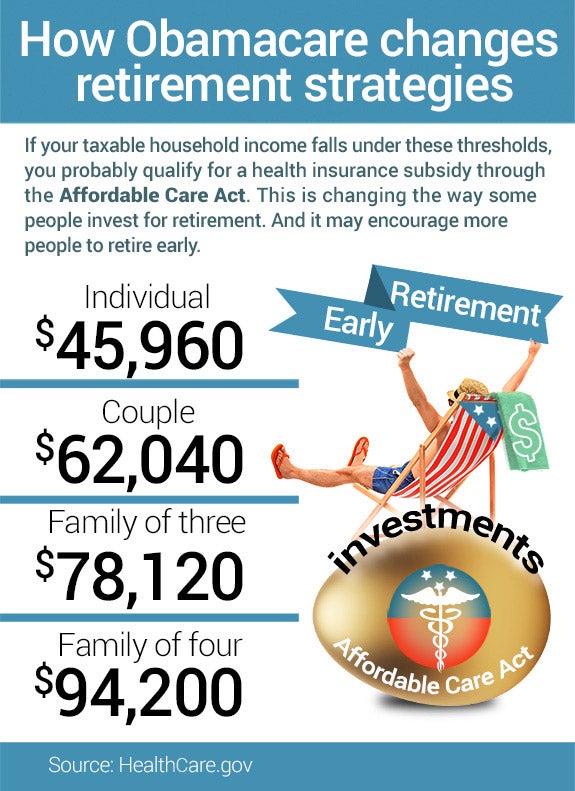
How Obamacare changes retirement strategies | Happy male on a beach chair: © Ljupco Smokovski/Shutterstock.com, Gold egg: © xtock/Shutterstock.com, Medical icon: © mamanamsai /Shutterstock.com


Certified Financial Planner professional Erik Carter of Financial Finesse says the availability of health care makes it easier to walk away from a job. "Simply put, many employees we work with have radically changed their retirement planning because of the health care law," he says.

Carter doesn't believe this is changing most Americans' retirement plans, but it is creating new possibilities for some. "A lot of people were staying in their jobs for the health insurance. Now that they don't have to, they're looking at ways to get investment income earlier and not rely on their job," he says. "This is a big win for people in their late 50s and early 60s who may have enough savings to retire but stick around for the health insurance."

Tax credits help lower costs

Carter says early retirees can more easily qualify for health insurance subsidies. "The law also incentivizes people to have more money in accounts other than a pretax 401(k)," he adds.
Currently, individuals earning between $11,490 and $45,960 may qualify for lower premiums when buying insurance on an exchange. The range for qualifying couples is $15,510 to $62,040. Any withdrawals from pretax accounts such as traditional IRAs and 401(k)s are taxed at ordinary rates. But withdrawals from accounts such as Roth IRAs and Roth 401(k)s don't count toward income since they are purchased with money that has already been taxed.
"Tax-free money makes it easier to qualify for the new health insurance subsidies," says Carter.
But that's a two-edged sword, he adds. "Because the health care subsidies are not asset-tested, this means a lot of retirees who don't qualify for Medicare can manipulate their investment income to fall below the threshold for Obamacare subsidies by moving money between taxable and nontaxable retirement accounts, and you'll have more people collecting subsidies than initially projected." That would likely put more strain on the health care system, he says.

Insurance more affordable for some

Missouri-based nurse Stephanie Payne is retiring this year to focus on writing about end-of-life care. "I was a nurse for 30 years, saved in my IRA and kept a close eye on my finances. I wanted to retire two years ago, but I couldn't afford it then. Getting health insurance on my own would have cost $1,200 a month. Now, my health insurance is $500 per month for the same deductible and coverage," she says.
Although Payne says she had enough passive income to pay for her basic needs a long time ago, she was stuck in her job for years because health care was too expensive. "I couldn't afford to pay that much for health insurance, so I kept working. In my job, my copay was $219 per month, and an extra $1,000 per month out of pocket just wasn't doable."
Although her health insurance costs are set to rise by nearly $300 per month when she leaves her job, Payne says she can afford that. "I won't use my car as much, so I'll save on gas, which will help. I'm also going to downsize my lifestyle," she says.
For Payne, the best part of being able to retire early is that she will get to move. "It's been a dream to move to Oregon for quite a long time and I can do that now."

Sunday, July 27, 2014

5 renovations that can alter home insurance


5 renovations that can alter home insurance


Renovating? Remodel insurance, too

 
Renovating? Remodel insurance, too © Sebastian Duda/Shutterstock.com
Planning a home renovation can involve fun activities such as designing a new floor plan or picking fixtures and paint colors. Having a heart-to-heart with your home insurance carrier may not be part of your preparations. But it should be.
"A renovation may affect the value of your home or the liability issues," says Don Griffin, vice president of personal lines at the Property Casualty Insurers Association. "Anything that changes the structure or use of the property can change your policy."
Many house improvements that boost your home's value could render your home insurance coverage inadequate and leave you vulnerable to losses. Other upgrades may trigger lower premiums -- savings you don't want to miss simply because you didn't call your insurer.
"When making improvements to your house, it's a good time to have an insurance conversation to get enough coverage and possibly discounts," says Richard Hutchinson, a general manager at Progressive Insurance.
Here's how five common home upgrades or repairs can affect your homeowners insurance policy, both positively and negatively.

New roof


Renovating? Better remodel your insurance, too © Johnny Habell/Shutterstock.com

A new roof may not be the sexiest home improvement, but it sure can save a lot of cash when it comes to homeowners insurance, cutting your premiums by 10 percent to 20 percent, says Jim Towns, an Allstate Insurance agency owner in Illinois.
"The roof is probably the single biggest factor affecting your policy," he says. "That's where the majority of losses due to snow, wind, hail and rain occur."
Some homeowners can get even bigger discounts if they live in hurricane-, wind- or hail-prone states and their new roof employs special loss-mitigation measures, such as hurricane straps, waterproofing or the very best shingles, says Brad Lemons, a vice president with Nationwide Insurance. To guarantee discounts, make sure to get a contractor's documentation that the upgrades are up to the strictest codes.
"It will vary company to company and state to state," he says.
While most home policies cover roofs, some insurers use depreciation schedules based on the age of the roof to determine how much protection you get, says Hutchinson. If it's too old, some policies won't cover it at all. But the newer the roof, the more the insurer will spend to replace it.

New pool

New pool © Lucy Clark/Shutterstock.com

A pool may make you the most popular house on the block, but it means your home is the riskiest, too, from an insurance standpoint.
"This is what our industry calls an 'attractive nuisance,'" says Griffin. "Everyone in the neighborhood wants to play in your pool. It increases your exposure to loss."
The standard policy usually comes with $100,000 in personal liability protection, which would cover medical costs for a person injured in your pool and any legal expenses if you're sued. However, an insurer may recommend that a pool owner opt for at least $500,000 in liability coverage, which would cost more, says Hutchinson.
The insurer also may require a fence around the pool with a lock to cover the newly built liability, he says. If the pool has a diving board or slide, it will be considered an even greater potential hazard. Hot tubs bring added danger, but the risk can be mitigated with covers and locks.
"The ratio between fun and risk is high," Hutchinson says. "The cool stuff will cost you more."
Also, don't forget to increase your homeowners coverage amount to compensate for the value of the pool, he says.

Office for a home business


Office for a home business © Stokkete/Shutterstock.com

Say you want to go full time making reclaimed-wood furniture at home for your Etsy site. Will your home insurance cover the assets of your newfound business? It depends on their value.
Most homeowners policies protect equipment for home-based businesses, but only up to about $2,500, says Hutchinson. That might not be enough for a business owner who uses specialized machinery or stores large amounts of supplies or inventory. Fortunately, you may need to just bolster your existing policy.
"It could be as simple as adding a rider or endorsement," says Lemons, using two words for policy amendments. "Or, depending on the complexity of the business, you may have to purchase an additional business policy."
That's particularly true if your business is the type that creates heavier foot traffic in your home -- such as piano lessons or private yoga sessions. The risk increases that you could be sued by a client or customer.
The good news: If your business doesn't bring visitors to your home and requires little equipment or supplies outside of a basic computer, your existing home policy should do the trick. But it's best to call your insurer first to make sure.

More living space


Sometimes a home needs to grow to accommodate an expanding family. That can mean adding more livable square footage where none existed before, such as in a dank basement or humid attic above the garage. In other instances, a new addition may be in order.
Your insurance will need to be altered to account for the value of the new space, in case a catastrophe strikes. "If you add 1,000 square feet to a home, it could add anywhere from $100 per square foot or more to your home," says Hutchinson.
Let your insurer know about any major addition even before you begin, says Towns. "Say you put on a room addition and three-quarters of the way through, a fire destroys it," he says. "You want that to be covered."
You may need to consider other types of coverage for the newly built-out areas of your home. A finished basement with new carpet, drywall and insulation may need water backup coverage if the sump pump is located there, says Towns.
And if you plan to rent out the new space, you'll need landlord coverage, says Hutchinson.
"Insurers view renters as higher risk than the people who own and occupy," he says.

Kitchen and bath upgrades

Kitchen and bath upgrades © Sergey Karpov/Shutterstock.com

Sometimes nothing can give a house the facelift it needs quite like making over a kitchen into a chef's dream or a master bathroom into a spa sanctuary. But unless you give your home insurance a makeover, too, the renovation may be at risk.
For example, say your insurer based your coverage on a kitchen with laminate countertops and generic cabinets. But then you spend $40,000 on granite countertops, custom cabinets and top-of-the-line appliances. Would your existing coverage be sufficient to rebuild your remodeled kitchen after a disaster?
"Most often the answer is no because people don't keep up (their policy) with the additions and alterations they are doing," says Lemons. "And they don't realize it until after a loss."
He recommends not only calling your insurer about the renovation but also providing records and photos to validate what you've had done. Your premium most likely will go up because your home is worth more.
One small bonus: Your contractor may upgrade the home's electrical or plumbing systems during a kitchen or bath renovation, especially in older homes. So, you could wind up with an insurance discount, says Towns, and that should offset some of the increased coverage costs.

Though upgrades may bring higher insurance costs, you might easily find lots of ways to save.